




Expert-Recommended Supplements for Anxiety†
Anxiety & Depression Supplements
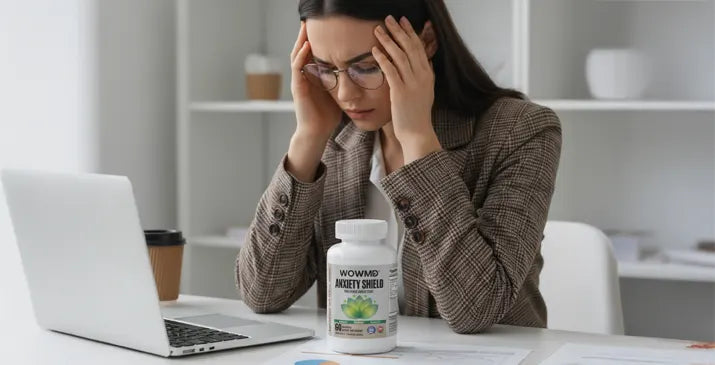
Supplements for Anxiety can help promote relaxation and contribute to overall mental well-being.†
Feeling overwhelmed, low, or constantly on edge is more common than you might think. Millions of adults struggle with anxiety and depression every day, and finding the right support can feel like a challenge in itself. The good news is that targeted nutritional support may help. WOWMD's anxiety and depression supplements are formulated with science-backed ingredients designed to support mood balance, emotional resilience, and daily well-being, from the inside out.

Anxiety Shield

Magnesium Glycinate

Reishi Relax Gummies

Reishi Calm Drops

B-12 Complex Liquid

Ashwagandha Extra Strength Formula

Saffron Extract

Ginkgo Biloba
Understanding Anxiety & Depression: Why Nutritional Support Matters
Understanding why nutritional support matters is the first step toward making an informed choice for your mental well-being.
The Link Between Nutrition and Mood
Anxiety and depression are among the most common wellness concerns adults face today, and you are far from alone in seeking tools to help manage them. What many people don't realize is that the brain depends on specific nutrients to produce mood-regulating neurotransmitters like serotonin, dopamine, and GABA. When those nutrients fall short, your ability to maintain emotional balance can be affected. Key nutrients like magnesium, vitamin D, omega-3 fatty acids, and B vitamins play meaningful roles in supporting the brain's stress response and psychological function.
How Stress Depletes Your Nutritional Reserves
Chronic stress dysregulates the HPA (hypothalamic-pituitary-adrenal) axis, leading to elevated cortisol that depletes magnesium stores and suppresses serotonin synthesis. Restoring key micronutrients can help modulate this stress-response loop. Emerging research also points to the gut-brain axis, the bidirectional communication network between the enteric nervous system and the brain, as a key pathway through which nutritional status influences mood.
Key Nutrients Your Brain Relies On
Magnesium is involved in over 300 biochemical reactions and directly regulates the nervous system. Omega-3s support healthy brain structure, while B6 and B12 are essential cofactors in neurotransmitter synthesis. Vitamin D receptors are found throughout the brain, including in regions governing mood regulation, and vitamin D deficiency has been associated with higher rates of depressive symptoms across multiple population studies. Zinc is a lesser-known but important cofactor in GABA and serotonin metabolism, and low serum zinc levels have been observed in individuals with both anxiety and depression.
What Supplements Can (and Cannot) Do
It is important to be clear. Supplements are not a treatment for clinical anxiety or depression, nor a substitute for professional care. What they can do is support your body's natural processes, helping build a stronger nutritional foundation for emotional well-being.
Key Ingredients in Anxiety & Depression Supplements: What the Evidence Says
Understanding which ingredients actually have research behind them, and at what dosages, is the most important step in choosing a supplement that may genuinely support your mood.
Magnesium Glycinate
Magnesium glycinate modulates NMDA receptors in the brain and helps regulate cortisol output, making it one of the most studied minerals for stress and low mood. Multiple randomized controlled trials support its role in reducing anxiety symptoms. Typical studied dosage: 300 to 400 mg per day. Magnesium glycinate is significantly better absorbed than cheaper forms like magnesium oxide, which matters for real-world results.
Omega-3 Fatty Acids (EPA and DHA)
Omega-3 fatty acids support brain membrane fluidity and exert anti-inflammatory effects that are directly relevant to mood regulation. EPA-dominant formulas have the strongest evidence base for depressive symptoms, with several meta-analyses of randomized controlled trials supporting their use. Typical studied dosage: 1 to 2 g of EPA per day.
Ashwagandha (KSM-66 or Sensoril Extract)
Ashwagandha is an adaptogen, a stress-response herb that modulates the HPA axis to reduce cortisol output and improve stress tolerance. KSM-66 and Sensoril are among the most clinically studied root extracts, with human trials showing meaningful reductions in perceived stress and anxiety scores. Typical studied dosage: 300 to 600 mg per day.
Rhodiola Rosea
Rhodiola rosea is another well-regarded adaptogen with evidence for reducing fatigue and improving resilience under stress. It works through a different mechanism than ashwagandha, making the two complementary in multi-ingredient formulas. Typical studied dosage: 200 to 400 mg per day.
L-Theanine
L-theanine, an amino acid found naturally in green tea, promotes alpha brain wave activity, a state associated with calm alertness, without causing sedation. It is particularly well-studied for anxiety and is often paired with magnesium for a synergistic calming effect. Typical studied dosage: 100 to 200 mg.
Vitamin D3
Vitamin D receptors are expressed throughout the limbic system, the brain's emotional processing center. Supplementing with D3, the most bioavailable form, is especially relevant for people with limited sun exposure. Typical studied dosage: 1,000 to 2,000 IU per day.
B-Complex (B6 as P-5-P and B12 as Methylcobalamin)
B vitamins are essential raw materials for serotonin and dopamine synthesis. The active forms, pyridoxal-5-phosphate (P-5-P) for B6 and methylcobalamin for B12, are more readily used by the body than synthetic alternatives, particularly for people with MTHFR gene variants that impair conversion.
Saffron Extract
Saffron extract at 30 mg per day has shown results comparable to low-dose SSRIs in several small randomized controlled trials for mild-to-moderate depressive symptoms. While the evidence base is still growing, it is one of the more promising botanical ingredients in this category.
Zinc
Zinc serves as a cofactor in both GABA and serotonin metabolism. Low serum zinc has been consistently observed in individuals with anxiety and depression across epidemiological studies. Typical studied dosage: 15 to 30 mg per day.
SAMe (S-Adenosyl Methionine)
SAMe is a naturally occurring compound involved in methylation reactions that support neurotransmitter production. It has been researched specifically for depressive symptoms and is sometimes used as an adjunct to conventional care under medical supervision.
Dosage matters as much as ingredient selection. Many products underdose key compounds to reduce manufacturing costs. Always check that a supplement lists the specific form and amount of each ingredient, not just the ingredient name.
How to Choose an Anxiety & Depression Supplement: What to Look For (and Avoid)
Not all mood-support supplements are created equal. The form of an ingredient, the dosage used, and the manufacturing standards behind a product all determine whether it is likely to make a real difference.
- Check for named ingredient forms: Look for magnesium glycinate (not just "magnesium"), methylcobalamin (not just "B12"), and P-5-P (not just "B6"). The specific form determines how well your body can actually use it.
- Avoid proprietary blends: When a label lists a "blend" with a single combined weight, you have no way of knowing whether any individual ingredient is present at a meaningful dose.
- Prioritize GMP-certified manufacturing: Good Manufacturing Practice certification means the facility meets federal standards for quality, consistency, and safety. Look for products made in FDA-registered, GMP-certified facilities.
- Look for third-party testing or a certificate of analysis (COA): Independent verification from organizations like USP, NSF International, or Informed Sport confirms that what is on the label is actually in the bottle, at the stated potency.
- Check for unnecessary fillers, artificial colors, and common allergens: If you have sensitivities, a clean label matters as much as the active ingredients.
Holistic Habits That Support Mood Balance
Good supplementation is only one piece of the puzzle. The most meaningful, lasting improvements to mood and emotional well-being come from building healthy daily habits that work alongside your nutritional support.
Move Your Body, Calm Your Mind
Regular physical activity, even moderate movement like walking, cycling, or yoga, reduces anxiety and low mood by releasing endorphins and supporting healthy neurotransmitter levels. Quality sleep is equally foundational, as poor rest amplifies emotional reactivity and makes stress harder to manage.
Nourish Your Brain Through Daily Habits
Mindfulness, journaling, and time outdoors strengthen emotional resilience over time. A nutrient-rich diet featuring healthy fats, whole grains, leafy greens, and fermented foods nourishes both brain and gut. Fermented foods like kefir, kimchi, and yogurt introduce beneficial Lactobacillus and Bifidobacterium strains that produce short-chain fatty acids and neurotransmitter precursors, directly supporting the gut-brain axis.
Where Supplements Fit In
Supplements for anxiety and depression support work best layered on top of these healthy foundations, not as a substitute. WOWMD's expert-recommended formulas are designed to complement the positive steps you are already taking. And for persistent or severe symptoms, reaching out to a mental health professional is always a valuable option.
The Gut-Brain Axis and Mood, Why Your Gut Health Matters
Approximately 90% of the body's serotonin is produced in the gut, which means the health of your digestive system has a direct and measurable impact on your mood.
How the Gut and Brain Communicate
The gut and brain communicate continuously through the vagus nerve, a long cranial nerve that acts as a two-way highway between the enteric nervous system (the gut's own neural network) and the central nervous system. When the gut microbiome is disrupted by poor diet, stress, or antibiotics, this signaling pathway can be compromised, contributing to changes in mood, anxiety, and stress response.
Psychobiotics and the Strains Worth Knowing
Specific probiotic strains have been studied for their effects on mental health. Lactobacillus rhamnosus (particularly the JB-1 strain) has been studied in animal models for its ability to modulate GABA receptor expression. Bifidobacterium longum (1714 strain) has been investigated in human trials for its effects on stress and anxiety scores. These strains, along with others that produce short-chain fatty acids and neurotransmitter precursors, are sometimes referred to collectively as psychobiotics, probiotics and prebiotics that influence mental health via the gut-brain axis.
What You Eat Shapes How You Feel
Diet plays a central role here too. Research in epidemiological studies has associated a diet high in ultra-processed foods with disrupted microbiome diversity and higher rates of depressive symptoms. Prioritizing whole foods, fiber, and fermented options supports a healthier microbial environment. Omega-3 fatty acids also reduce gut inflammation, making them doubly relevant for mood support, both at the brain level and within the gut-brain connection.
FAQs
What People are Saying

Loading review…

Loading review…

Loading review…

Loading review…

Loading review…

Loading review…

Loading review…

Loading review…

Loading review…
Why Choose WOWMD for Anxiety & Depression Supplements?
At WOWMD, we understand that anxiety and mood challenges are deeply personal, which is why our formulas are developed with input from dietitians and natural medicine doctors who bring real clinical expertise to every product. We use science-backed ingredients at transparent dosages, with no fillers and no cutting corners.
Every WOWMD supplement is made in the USA in a GMP-certified, FDA-registered facility and backed by our 60-day money-back guarantee. If you are ready to take a thoughtful step toward greater emotional balance, browse our expert-recommended collection and find the formula that is right for you.
References:
- The Role of Sleep in Emotional Brain Function - https://pmc.ncbi.nlm.nih.gov/articles/PMC4286245/
- The Impact of Nutrients on Mental Health and Well-Being: Insights From the Literature - https://pmc.ncbi.nlm.nih.gov/articles/PMC7982519/
‡May help support the Mental health of those who are in search of improving their Anxiety & Depression issues.†
†These statements have not been evaluated by the Food and Drug Administration. These products are not intended to diagnose, treat, cure, or prevent any disease.†
SUBSCRIBE & SAVE UP TO 30%
Subscribe to your favorites WOWMD® supplements and enjoy flexible deliveries, easy account control, and savings on select products. FREE U.S. SHIPPING on orders over $60!
Shop Subscribe & Save
Expert Advice About Anxiety & Depression Supplements
Learn more about Anxiety & Depression Supplements through recommendations, product guides and wellness education from trusted professionals

REAL CUSTOMERS. REAL REVIEWS.


NEED HELP SELECTING WHAT'S BEST FOR YOU?


Why Trust WOWMD®?
At WOWMD®, our purpose is clear: To deliver products you can trust and results you can feel. We know that when it comes to your health, there’s no room for compromise. That's why we use only the purest ingredients, backed by cutting-edge research, to craft supplements that truly make a difference. Every formula is carefully designed to support your wellness journey—because we believe you deserve nothing less than the best.
Trust isn't just a word for us: It's the foundation of everything we do. We understand that taking care of your health is deeply personal, and we’re here to support you every step of the way. With WOWMD®, you're choosing a brand that’s committed to your well-being—not just today, but for the long haul. Let us be your partner in health, providing the reliability and confidence you deserve.