

Best Vitamin B12 Supplements for Vegans: How to Choose and What We Recommend (2026)
Compare vegan B12 supplements by dosage, absorption, ingredients, and value.
 By WOWMD Staff

 Fact Checked
Advertiser Disclosure: WOWMD independently vets all recommended products. If you purchase a featured product, we may be compensated. Learn why you can trust us.


Vegans need a reliable B12 source from fortified foods or a supplement, because plant foods don’t naturally contain usable B12. For most adults, a daily supplement with at least 10 µg, or a weekly dose of at least 2,000 µg, meets the Vegan Society’s guidance. Cyanocobalamin and methylcobalamin both work at these doses.
The high numbers on supplement labels are deliberate. Your body absorbs only a small share of a large dose, so a 1,000 µg tablet delivers far less than the label suggests.
In this guide, you’ll learn why B12 matters on a vegan diet, how absorption works, how to choose a form and format, when a standard supplement isn’t enough, and how four vegan B12 supplements compare.
In this guide: Why B12 matters for vegans · How much you actually absorb · How to choose · When it isn’t enough · How we evaluated · The picks · Building the habit · What the Vegan Society says · FAQ
TL;DR
- Plant foods don’t naturally contain usable B12. Vegans need fortified foods or a supplement.
- The Vegan Society recommends at least 10 µg daily, at least 2,000 µg weekly, or fortified foods two to three times a day for at least 3 µg.
- Large doses are normal because absorption drops as the dose rises. About 1.3% of a 1,000 µg dose is absorbed.
- According to the NIH, absorption doesn’t vary meaningfully by B12 form, and sublingual and oral forms work about equally well.
- Chew or dissolve B12 tablets in your mouth, as the Vegan Society advises.
- Metformin, acid-reducing drugs, pernicious anemia, gut surgery, and pregnancy all call for medical guidance.
- Spirulina, nori, and tempeh are not reliable B12 sources.
Why B12 Is Non-Negotiable for Vegans
If you follow a vegan diet, you cannot afford to overlook vitamin B12. Unlike iron, zinc, or omega-3s, which have plant sources (even if absorption varies), B12 isn’t naturally present in plant foods at all. It’s produced by microorganisms and reaches the human diet almost entirely through animal products. When those come off the table, so does your most reliable dietary source.
The gap is measurable. A 2022 review in the European Journal of Nutrition put average daily B12 intake at 7.2 µg in meat-eaters but only 0.4 µg in vegans, roughly a sixth of the adult RDA from diet alone.
How often that intake gap turns into clinical deficiency is genuinely harder to pin down, and we’d rather give you the honest version than a tidy number. Pawlak and colleagues’ review of 40 studies found deficiency prevalence among vegetarian adults and elderly ranging from 0% to 86.5%, depending on the population studied and the cutoff used.
What the review states plainly is the part that matters: deficiency was consistently higher in vegans than in other vegetarians, and vegans who don’t supplement are at especially high risk. The authors also note the true prevalence is probably higher than reported, because serum B12 is an imperfect marker: you can test normal and still be deficient.
Why it matters clinically: your nervous system needs B12 to maintain the myelin sheath around nerve fibers, your red blood cells need it to form properly, and your body uses it to synthesize DNA. When levels fall too low, it can cause fatigue that sleep doesn’t fix, tingling or numbness in the hands and feet, brain fog, and mood changes. Left long enough, it causes permanent nerve damage.
Registered Dietitian Reed Mangels, PhD, RD, nutrition advisor to The Vegetarian Resource Group, puts the stakes simply: “Although recommendations for vitamin B12 are very small, a vitamin B12 deficiency is a very serious problem leading ultimately to irreversible nerve damage.”
This sneaks up on people because of storage. Your liver holds a multi-year reserve, so you can feel fine for a long time while the tank drains. By the time something feels off, you may have been running low for months.
Deficiency can creep up slowly. The body stores about 1 to 5 mg of B12, so symptoms can take years to appear. “In the absence of a daily supply, signs of deficiency can appear in as little as a year,” note Dr. Eve Glazier and Dr. Elizabeth Ko, internists at UCLA Health.
Fortified plant milks, cereals, and nutritional yeast can help, but amounts vary by brand. “As a vegan, you're now going to have to rely on supplements to be sure you get enough B12,” Dr. Glazier and Dr. Ko advise. Once you plan to supplement, the next question is how much your body actually absorbs.
The One Thing Most B12 Guides Get Backward
If you’ve wondered why a supplement contains 1,000 µg when the RDA is 2.4 µg, here is the answer, and many articles get the mechanism backward.
B12 is absorbed by two routes. The main one is active transport: B12 binds to intrinsic factor, a protein secreted in your stomach, which ferries it across the gut wall. This route is efficient but saturable: it can transport only a small amount per dose, and once its capacity is exceeded, absorption of the rest drops sharply.
The second route is passive diffusion, which absorbs roughly 1% of what is left over ( NIH Office of Dietary Supplements). It’s wildly inefficient, but unlike the active route, it doesn’t saturate. That’s the whole trick: high-dose supplements aren’t trying to beat the intrinsic-factor ceiling, they’re deliberately overwhelming it so that the inefficient-but-unlimited route delivers a useful amount.
The numbers make it concrete. The Vegan Society’s guidance notes that about 50% of a ~1 µg dose is absorbed, but only about 0.5% of a 1,000 µg dose. The NIH Office of Dietary Supplements reports a similar pattern: roughly 56% of a 1 µg oral dose is absorbed. In contrast, only about 10 µg of a 500 µg supplement reaches healthy people.
|
Dose |
Share absorbed |
Approximate amount absorbed |
|
About 1 µg or less |
About 50% |
About 0.5 µg |
|
500 µg |
About 2% |
About 10 µg |
|
1,000 µg |
About 0.5% to 1.3% |
About 5 to 13 µg |
So a 1,000 µg tablet doesn’t give you 1,000 µg. It gives you something in the range of 5–10 µg, which is exactly what you need it to do, and exactly why the dose on the label looks absurd next to the RDA. It’s not marketing inflation. It’s arithmetic.
Two practical consequences:
-
A big daily dose and a bigger weekly dose are both valid because absorption drops as the dose rises. That’s why the Vegan Society’s daily figure (10 µg) and weekly figure (2,000 µg) look so disproportionate to each other.
-
Chewing matters. The Vegan Society specifically advises that “any B12 supplement tablet should be chewed or allowed to dissolve in the mouth to enhance absorption.” If you swallow chewable tablets whole, you’re working against the format.
How to Choose the Right Vitamin B12 Supplement
Once you know you need a supplement, four things matter: the form, the dose, the format, and the product’s quality standards.
Form: methylcobalamin or cyanocobalamin
The two common forms are cyanocobalamin (synthetic, extremely stable, the most-studied form, and the one used in most of the research the recommendations are built on) and methylcobalamin (a form your body uses directly).
For most healthy adults, either works to maintain adequate levels, and the marketing story that methylcobalamin is “the better, active form” is more complicated than it looks.
Here’s the nuance most guides skip. The body has two active coenzyme forms of B12: methylcobalamin and adenosylcobalamin. They do different jobs: methylcobalamin works with folate in blood cell formation, while adenosylcobalamin supports fat and amino-acid metabolism and myelin formation. Thakkar and Billa, writing in the European Journal of Clinical Nutrition, argue that promoting methylcobalamin alone overlooks this, and that deficiency is better addressed with a combination, or with cyanocobalamin or hydroxocobalamin, which the body converts into both active forms as needed.
We’re including that because it runs counter to a claim our own category makes, including on our own label. The practical upshot for a healthy vegan maintaining status rather than treating a diagnosed deficiency: any of these forms at an adequate dose will keep your levels where they need to be, and consistency matters far more than the prefix on the molecule. If you’re treating an actual diagnosed deficiency, that’s your clinician’s call, not a shelf decision.
A note on MTHFR: you’ll see claims that people with an MTHFR gene variant should choose methylcobalamin. We’ve left that advice out. MTHFR affects folate metabolism, and no good evidence suggests MTHFR status should change which form of B12 you take. If you have a diagnosed methylation issue, that’s a conversation with your clinician, not a reason to pay more for a capsule.
Dose
Read the absorption section above first. It explains why the numbers look the way they do. Standalone vegan B12 supplements typically run 500–2,500 µg per serving. The Vegan Society sets a floor of at least 10 µg daily, or 2,000 µg weekly. The Vegetarian Resource Group’s guidance is in the same territory: 25–100 µg daily, or 1,000 µg twice weekly.
Anything in that range, taken consistently, works. Higher isn’t better; it just means less is absorbed.
Delivery format
Sublingual tablets, lozenges, and sprays dissolve in the mouth. They’re a reasonable choice, and if a format makes you more likely to take it daily, that alone justifies it.
We’d flag one caveat, because it’s routinely overstated elsewhere: head-to-head trials find sublingual and oral B12 raise serum levels about equally in people with normal absorption. Sublingual formats are not a magic bypass. High-dose oral B12 already works around intrinsic factor via passive diffusion, so “bypasses intrinsic factor” isn’t a difference between the two. If you have a diagnosed absorption disorder, pernicious anemia, or you’ve had gastric surgery, that’s a medical conversation, not a format choice.
Quality markers
- Third-party tested for purity and potency
- Manufactured in a GMP-certified, FDA-registered facility
- B12 form and dose per serving stated clearly on the label
- No gelatin in the capsule shell or gummy base
- Vegan certification, if third-party verification matters to you
When a Standard Supplement Isn’t Enough
Everything above assumes normal absorption. For some people, that assumptiondoesn’tt hold, and a shelf supplement is the wrong tool. This is the section most vegan B12 guides leave out entirely.
If you take metformin or a stomach-acid drug, your B12 needs watching. This is well established and widely under-flagged. Metformin interferes with the calcium-dependent step that intrinsic factor needs; proton pump inhibitors and H2-receptor antagonists suppress the gastric acid that frees B12 from food in the first place. A 2018 review in Advances in Nutrition sets out the mechanisms and clinical implications, and the NIH Office of Dietary Supplements advises that anyone taking these medications regularly should discuss their B12 status with their healthcare provider.
Note: these drugs mainly impair absorption of B12 from food, so a supplement is often still effective, but the sensible move is monitoring, not assuming.
Talk to a doctor rather than relying on a supplement if you have: pernicious anemia (an autoimmune loss of intrinsic factor), a history of gastric or bowel surgery including bariatric procedures, Crohn’s or coeliac disease, or atrophic gastritis, which becomes more common with age. These conditions may require injections or prescription-strength dosing that no over-the-counter product can replace.
Pregnancy and breastfeeding raise the stakes. The infant depends entirely on maternal status, and deficiencies in the first months of life can cause developmental harm that later supplementation does not fully reverse. A 2022 European Journal of Nutrition review estimates deficiency prevalence among vegetarian and vegan pregnant women at 17–39% in lower-socioeconomic settings. If you’re pregnant, planning to be, or breastfeeding on a vegan diet, this is a conversation to have with a midwife or dietitian rather than a decision to make from a product page.
See a doctor, don’t self-treat, if you already have numbness or tingling in your hands or feet, balance problems, memory changes, or persistent unexplained fatigue. Those can signal an established deficiency, and they need testing and proper treatment, not a shelf bottle
How We Evaluated These Products
We scored every product on five equally weighted criteria: form and dose adequacy (does a normal serving meet the Vegan Society floor?), label transparency, third-party testing and manufacturing standards, vegan integrity (capsule shell, binders, flavorings), and cost per serving at the labeled dose.
The Picks
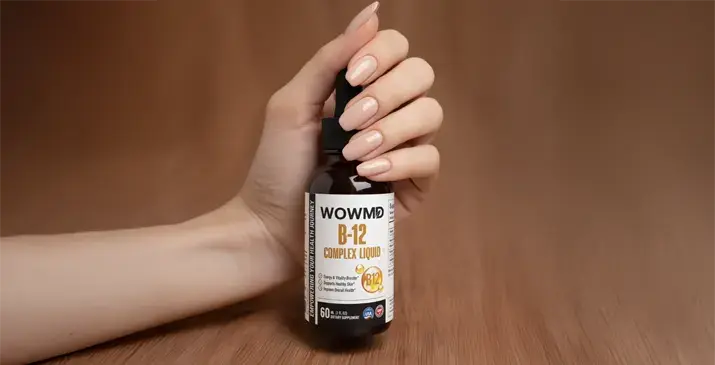
1. WOWMD® B12 Complex Liquid: Best Overall

Shop WOWMD B-12 Complex Liquid
This is our own product. Here’s the case, and the honest caveat.
Each serving delivers 1,000 µg of methylcobalamin, comfortably above the Vegan Society’s daily floor and in the absorption range where the maths works in your favor. The formula is non-GMO, with no artificial additives, in a plant-based capsule shell with no gelatin or animal-derived fillers, and is manufactured in a GMP-certified, FDA-registered facility in the USA.
At roughly $0.83 per serving, this is about three times the per-serving cost of Naturelo’s comparable 1,000 µg capsule. You’re paying for the manufacturing standard and clean label, not more B12. If cost per serving is your deciding factor, Naturelo is the rational pick, andwe’dd rather you take something consistently than nothing at the right price.
Pros:
- 1,000 µg methylcobalamin
- Plant-based capsule
- GMP-certified USA manufacturing
- No artificial additives
Cons:
- Most expensive per serving in this guide
- Capsule only (no sublingual or spray)
- Two capsules per serving
2. MegaFood Vegan B12: Best Whole-Food Formula

MegaFood layers three B vitamins (B6, B9 as folate, and B12) with beetroot and organic broccoli. Per MegaFood’s own product page, the formula “includes beetroot, organic brown rice, and organic broccoli alongside added nutrients.”
At 500 µg, the B12 dose still clears the Vegan Society’s 10 µg daily floor with enormous headroom, so “lower dose” here is not a shortcoming for daily use. It’s only relevant if you’re doing weekly mega-dosing, for which this isn’t the right product.
Pros:
- Whole-food matrix
- Covers B6 and folate too
- No artificial additives
- Tablet can be chewed
Cons:
- Not designed for weekly dosing
- Pricier per serving than Naturelo
3. Naturelo Vegan B12 with Spirulina: Best Value

Naturelo pairs 1,000 µg methylcobalamin with spirulina. Same headline dose as our own product at roughly a third of the price per serving, which is whyit’ss here.
One thing to know: spirulina contains pseudo-vitamin B12, an inactive analog that isn’t a usable B12 source, and some evidence suggests analogs may even interfere with the real thing. That’s not a strike against this product, though. The 1,000 µg of methylcobalamin does the real work. But it’s worth saying plainly, because the same claim gets made for nori, chlorella, tempeh, and unfortified nutritional yeast. None of them is a reliable B12 source. If a food is being sold to you as plant-based B12, assume it isn’t until the label shows added cyanocobalamin or methylcobalamin.
Pros:
- 1,000 µg methylcobalamin
- Best cost per serving here
- Single-capsule dose
Cons:
- Spirulina taste can carry over
- Don’t buy it for the spirulina’s B12
4. Garden of Life mykind Organics B12 Spray: Best Non-Capsule Option

Each spray delivers 500 µg of methylcobalamin and is certified organic and NSF-verified. Its main advantage is convenience, not superior absorption. If you struggle to swallow capsules or have stopped taking supplements because of their format, a spray may be easier to use consistently. A supplement that fits your routine is more useful than one you buy but rarely take.
Pros:
- No capsule to swallow
- Certified organic
- NSF verified
- Easy to travel with
Cons:
- Raspberry flavor won’t suit everyone
- Bottle needs tracking to know when it’s empty
Comparison
|
Product |
Dose |
Form |
Format |
~Cost/serving |
Best for |
|
WOWMD® B12 Energy Support |
1,000 µg |
Methylcobalamin |
Capsule |
~$0.83 |
Manufacturing standard, clean label |
|
MegaFood Vegan B12 |
500 µg |
Methylcobalamin |
Tablet |
~$0.60–0.73 |
B6 + folate in one |
|
Naturelo Vegan B12 |
1,000 µg |
Methylcobalamin |
Capsule |
~$0.25–0.32 |
Value |
|
Garden of Life mykind |
500 µg |
Methylcobalamin |
Spray |
~$0.35–0.43 |
Anyone avoiding capsules |
All four clear the daily threshold by a wide margin. The decision really comes down to format and price.
† These statements have not been evaluated by the Food and Drug Administration. These products are not intended to diagnose, treat, cure, or prevent any disease. Individual results may vary.
Making It Stick
Most people who fall short on B12 didn’t pick the wrong product. They stopped taking it. A routine you can keep for years matters more than any single label.
Anchor it to something you already do. Link the dose to an existing habit: your coffee, breakfast, brushing your teeth. Keep the bottle somewhere visible, and use a weekly pill organizer if you tend to forget.
Switch formats rather than quitting. If you’ve stopped taking a supplement because you disliked swallowing it, that’s a format problem, not a discipline problem. Sprays, chewables, and dissolvable tablets all work.
If you choose gummies, check two things: that the B12 is methylcobalamin or cyanocobalamin, and that the base is pectin rather than gelatin, since many mainstream gummies use animal-derived binders.
Consider weekly dosing. If daily tracking is the failure point, the Vegan Society explicitly supports at least 2,000 µg once weekly as a valid alternative. One recurring reminder is easier to sustain than seven.
Chew it. Worth repeating because it’s free: tablets should be chewed or dissolved in the mouth rather than swallowed whole.
Expect gradual, not dramatic. B12 rebuilds slowly. Give it eight to twelve weeks of consistent use before judging. If you want data rather than a guess, ask your doctor about testing, and keep in mind that serum B12 alone is an imperfect marker. Markers like methylmalonic acid (MMA) or holotranscobalamin give a better picture of functional status, which is why a 2024 meta-analysis in Nutrition Bulletin looked at functional B12 status specifically rather than serum levels alone. Your clinician will interpret any result in the context of your full health picture; we won’t hand you an “optimal range” to self-diagnose against.
What the Vegan Society Says
It’s worth reading the primary source rather than everyone’s summary. The Vegan Society’s B12 guidance gives three routes, and says to pick at least one:
- Eat fortified foods two or three times a day to get at least 3 µg of B12 daily
- Take one B12 supplement daily providing at least 10 µg
- Take a weekly B12 supplement providing at least 2,000 µg
That’s the whole recommendation. It is deliberately undramatic, and the three options exist because the absorption curve makes them roughly equivalent in effect.
People skip the part that all three require deliberate action. There is no passive version of this: no combination of whole plant foods that quietly covers B12 while you’re not paying attention. That’s not a marketing line; it’s why a membership organization dedicated to promoting veganism publishes a page insisting its members supplement.
B12 isn’t optional on a vegan diet. Pick a form you’ll take, a dose that clears the floor, and a format you won’t abandon, then take it consistently for years. The consistency matters far more than which of these four bottles you buy.
† These statements have not been evaluated by the Food and Drug Administration. These products are not intended to diagnose, treat, cure, or prevent any disease. Individual results may vary. This article is general information, not medical advice. Talk to your doctor or a registered dietitian about your own situation.
FAQs
This article is for informational purposes only and is not a substitute for professional medical advice, diagnosis, or treatment. Statements made on this website have not been evaluated by the U.S. Food and Drug Administration. Always consult a qualified healthcare professional before making changes to your diet, supplements, medications, or healthcare routine.