

Cyanocobalamin vs Methylcobalamin: Which Vitamin B12 Is Right for You?
A Guide to B12 Forms, Benefits, and Choosing the Right Supplement
 By WOWMD Staff

 Fact Checked
Advertiser Disclosure: WOWMD independently vets all recommended products. If you purchase a featured product, we may be compensated. Learn why you can trust us.


Vitamin B12 is non-negotiable for your body. It supports nerve function, red blood cell production, and energy metabolism. Without enough of it, you can feel persistently tired, mentally foggy, and physically off in ways that are hard to pin down.
The challenge is that B12 supplements come in different forms, and the two you will see most often are cyanocobalamin and methylcobalamin. This guide explains how they differ, what the research actually says, and how to choose the right one for your needs.
This article is for informational purposes only and is not a substitute for professional medical advice. Speak with your healthcare provider before starting any new supplement.
TL;DR
- Cyanocobalamin is the most common form of B12 in supplements. It is synthetic, stable, affordable, and well-researched.
- Methylcobalamin is one of the two active forms of B12 your body uses, so it does not need to be converted first.
- According to the NIH, there is no evidence that absorption rates of B12 supplements vary by form.
- Older adults, vegans, people with digestive conditions, and people taking metformin or acid-reducing medications have a higher risk of low B12.
- The best form is the one that fits your budget, preferences, and health needs, ideally chosen with your healthcare provider.
- Adults need just 2.4 mcg of B12 per day, though supplements often contain much more.
What Is Vitamin B12 and Why Does It Matter?
Vitamin B12, also called cobalamin, plays a role in several essential processes. According to the NIH Office of Dietary Supplements, the recommended dietary allowance for adults is 2.4 mcg per day, rising to 2.6 mcg during pregnancy and 2.8 mcg while breastfeeding.
What B12 Does in the Body
B12 helps your body turn food into usable energy, supports the production of healthy red blood cells, and keeps your nervous system working properly. It does not supply energy directly. Instead, as this guide on B12 and energy explains, it acts as a cofactor for the enzymes that break down carbohydrates, fats, and proteins.
Signs You May Be Low in B12
The NIH lists fatigue, neurological changes, and megaloblastic anemia among the effects of deficiency. Numbness and tingling in the hands and feet can occur even without anemia. For a deeper look at risk factors and symptoms, see this guide on what causes B12 deficiency.
ALSO READ: Vitamin B12 Deficiency: Causes, Symptoms, and Treatment
Advertisement

 *All individuals are unique. Your results can and will vary.
Cyanocobalamin vs Methylcobalamin: The Key Differences
Both forms deliver vitamin B12, but they take slightly different routes to get there.
Cyanocobalamin
Cyanocobalamin is a synthetic form of B12 and, according to the NIH, the most common form found in dietary supplements. It has been used for decades because it is stable, affordable, and well-studied. Once absorbed, your body converts it into the active forms it needs.
Methylcobalamin
The NIH identifies methylcobalamin and 5-deoxyadenosylcobalamin as the two metabolically active forms of B12. Methylcobalamin acts as a cofactor for methionine synthase, the enzyme that converts homocysteine into methionine. Because it is already an active form, it does not need to be converted before your body can use it.
What About Absorption?
This is where marketing often gets ahead of the evidence. Methylcobalamin is frequently described as more bioavailable, but the NIH states that no evidence indicates absorption rates of B12 in supplements vary by form. What does affect absorption is the dose. The NIH notes that about 50% is absorbed at doses below 1 to 2 mcg, while only about 2% is absorbed at 500 mcg and 1.3% at 1,000 mcg.
In practice, both forms can effectively raise B12 levels. The choice often comes down to personal preference, cost, and how a product is formulated.
Cyanocobalamin vs Methylcobalamin at a Glance
|
Factor |
Cyanocobalamin |
Methylcobalamin |
|
Type |
Synthetic form |
One of the body’s two active forms |
|
Conversion needed |
Yes, converted after absorption |
No, already active |
|
Absorption |
No evidence of difference by form, per NIH |
No evidence of difference by form, per NIH |
|
Stability |
Very stable; long shelf life |
More sensitive to light and heat |
|
Cost |
Usually more affordable |
Usually priced higher |
|
Common uses |
Mass-market supplements and fortified foods |
Supplements focused on active nutrient forms |
|
Vegan-friendly |
Yes, as a supplement |
Yes, as a supplement |
Cyanocobalamin: Stability and Cost-Effectiveness
The word “synthetic” often makes health-conscious shoppers pause. But understanding what it means for your body and your budget is worth doing before you rule it out.
Form and Stability
Cyanocobalamin is manufactured, which gives it one significant advantage: shelf stability. It holds its potency well during storage and shipping, which helps keep costs down. That is a big reason it became the standard in mass-market supplements and fortified foods.
Who It Works Well For
Cyanocobalamin is a reasonable choice if you are generally healthy and looking for an affordable way to close a dietary gap. It is widely available, its research base is extensive, and dosing is well understood.
Methylcobalamin: The Active Form
Methylcobalamin appeals to people who prefer a form their body can use without an extra conversion step.
Why People Choose Methylcobalamin
Because methylcobalamin is already one of the body’s active forms of B12, many people prefer it as a more direct option. It is also commonly chosen by people who prefer to avoid synthetic nutrient forms. Some people with MTHFR gene variants are advised to use active nutrient forms, though this is a decision best made with a healthcare provider, since the evidence for B12 specifically is limited.
The Tradeoffs
Methylcobalamin is generally more sensitive to light and heat, so it needs careful formulation and proper storage. It also tends to cost more than cyanocobalamin. Since the NIH has found no evidence that absorption differs by form, the extra cost is mainly a matter of preference rather than proven superiority.
Advertisement

 *All individuals are unique. Your results can and will vary.
Who Is Most at Risk of Low B12?
Whichever form you choose, the bigger question for many people is whether they need a supplement at all. The NIH highlights several groups at higher risk.
Older Adults
Depending on the definition used, between 3% and 43% of community-dwelling older adults have B12 deficiency based on serum levels. Age-related changes in stomach acid can make it harder to absorb B12 from food.
Vegans and Vegetarians
Natural food sources of B12 are limited to animal foods, so people who follow a plant-based diet have a higher risk. Fortified cereals and nutritional yeast can help, but many vegans rely on supplements.
People With Digestive Conditions
Conditions such as celiac disease and Crohn’s disease can make it harder to absorb enough B12 from food to maintain healthy stores.
People Taking Certain Medications
Metformin might reduce B12 absorption and significantly lower serum B12 levels. Proton pump inhibitors can also interfere with absorption from food by reducing stomach acid.
ALSO READ: Can You Take Vitamin B12 and CoQ10 Together?
Choosing the Right B12 for Your Needs
Both forms deliver meaningful B12 support. Here is how to match the right option to your situation.
You Want Affordable Daily Coverage
If your goal is consistent, reliable supplementation at a lower cost, cyanocobalamin gets the job done. It suits healthy adults who want an extra nutritional buffer.
You Prefer an Active Form
If you would rather take a form your body can use without conversion, methylcobalamin is the natural choice. It is a good fit for anyone building a routine around active nutrient forms.
You Follow a Vegan or Vegetarian Diet
Either form works well as a supplement. What matters most is taking B12 consistently, since plant foods do not naturally contain it.
You Have a Diagnosed Deficiency or Health Condition
If you are working with a doctor on a diagnosed deficiency, absorption issue, or condition such as pernicious anemia, follow their guidance on form, dose, and delivery method. Some people need injections rather than oral supplements.
Consider the Format and Timing
B12 comes as tablets, capsules, sublingual drops, strips, and injections. Liquid drops are easy to adjust and convenient for people who dislike swallowing pills. If you are wondering about timing, this guide covers whether you can take B12 on an empty stomach.
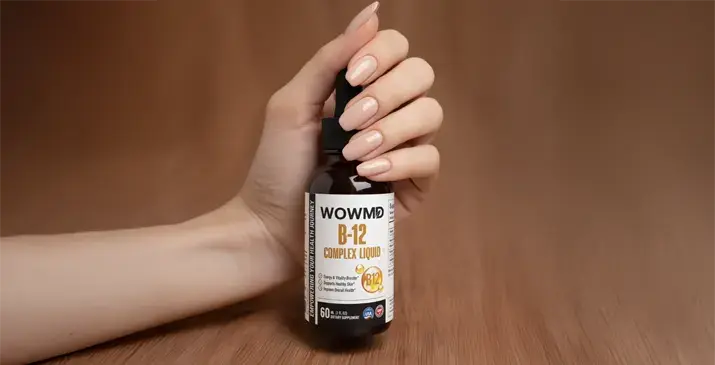
Top Pick: WOWMD B-12 Complex Liquid

WOWMD B-12 Complex Liquid: Best Methylcobalamin Liquid
Pros:
- Uses methylcobalamin, an active form of B12
- Combines B12 with vitamin B6, riboflavin (B2), and niacin (B3)
- Easy liquid drops, held under the tongue for 30 seconds before swallowing
- Vegan-friendly, non-GMO, gluten-free, and free of artificial additives
- Made in the USA in a GMP facility with laboratory testing for purity and potency
Cons:
- Liquid format requires shaking before use and measuring with a dropper
- Costs more than basic cyanocobalamin tablets
Key ingredients: Methylcobalamin (B12), Vitamin B6, Riboflavin, Niacin | Format: Liquid drops (60 mL) | Rating: 4.6/5 from 517 verified reviews
WOWMD B-12 Complex Liquid uses methylcobalamin to support normal energy metabolism, everyday focus, and nervous system wellness. Take 1 mL daily with the included dropper, preferably with a meal, and hold it under the tongue for 30 seconds before swallowing. First-time customers buying a single bottle are covered by a 60-day money-back guarantee.
"Started taking this a month ago and my energy levels are more stable throughout the day. No more afternoon crashes." Emily C
†These statements have not been evaluated by the Food and Drug Administration. These products are not intended to diagnose, treat, cure, or prevent any disease. Individual results may vary.
Advertisement

 *All individuals are unique. Your results can and will vary.
Final Thoughts
Cyanocobalamin and methylcobalamin both deliver vitamin B12, and according to the NIH, there is no evidence that one is absorbed better than the other. Cyanocobalamin offers stability and value, while methylcobalamin offers a form your body can use directly.
The right choice comes down to your budget, your preferences, and your health needs. If you prefer an active form in an easy liquid, WOWMD B-12 Complex Liquid is a convenient option. If you are in a higher-risk group, speak with your healthcare provider about testing your B12 levels first.
FAQs
This article is for informational purposes only and is not a substitute for professional medical advice, diagnosis, or treatment. Statements made on this website have not been evaluated by the U.S. Food and Drug Administration. Always consult a qualified healthcare professional before making changes to your diet, supplements, medications, or healthcare routine.